


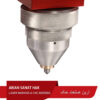
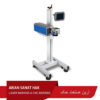
UV (ultraviolet) laser engraving machine is one of the most attractive and advanced technologies in the world of industrial lasers, which has a completely different nature from fiber and CO2 lasers.
UV Laser Engraving Machine
UV laser engraving is one of the advanced technologies in the printing and engraving industry that has attracted the attention of many industries and businesses due to its high accuracy, reasonable speed, and usability on a wide range of materials. This technology uses ultraviolet (UV) radiation to enable very precise and delicate engraving on various materials including plastic, glass, metal, leather, ceramics, and even some sensitive materials.
Function of UV laser engraving machine
UV laser engraving, also known as a “cold” laser, is a quantum leap in materials engineering and precision manufacturing. The core of this technology’s distinction lies in its short wavelength and the mechanism of interaction with the material, which allows it to engrave with micron resolution without thermal damage.
In the UV laser engraving process, a short-wavelength laser beam (usually in the 355 nm range) is focused on the surface of the material. Rather than creating high temperatures like CO2 or fiber lasers, this beam causes more molecular breakdown of the material’s surface, which results in very precise engraving with minimal damage to the material’s texture. This feature makes UV laser machines very suitable for engraving on delicate or thin materials.
Understanding the performance of a UV laser requires comparing it to more traditional lasers:
| Feature | Fiber laser (infrared) | Laser UV |
|---|---|---|
| Wave length | Long (usually 1064 nm) | Short (usually 355 nm) |
| Interaction method | Thermal | Photoalbation |
| Performance | Melting and evaporation of matter through heat | Direct breaking of molecular bonds (chemical decomposition) |
| Thermal effect | Top | Very low (cold engraving) |
| Accuracy | Top | Ultra high (small focal point) |
Advantages of UV laser engraving
High precision in engraving and no need for physical contact with the work surface. This minimizes human error and mechanical damage. UV machines are also capable of engraving very small materials, such as electronic components or small decorative pieces.
Another advantage is the ability to create permanent, environmentally-resistant engravings. UV laser engraved text or designs are highly resistant to abrasion, moisture, light, and chemicals, which is important in industries such as medical devices, automotive, or cosmetics.
UV laser engraving machine video
Photoalbation
The 355 nm wavelength in the ultraviolet spectrum contains very high-energy photons. When these photons strike the surface of a material, they provide enough energy to directly break the chemical bonds of the material (such as the carbon bonds in plastics). This process causes the material to turn into a gas directly and with minimal heat release (sublimation) rather than melting and thermally evaporating. The result is a very clean, burr-free cutting or engraving edge, with no thermal discoloration.
Key and unique competitive advantages
The UV laser bypasses the limitations of thermal lasers and enables a whole new range of applications:
A. Perfect surface quality (Minimal Damage)
In sensitive engravings, such as those on printed circuits or medical components, even a slight discoloration can mean damage. The UV laser ensures that:
- No heat affected zone (HAZ) is created.
- Extremely high precision micro holes are created in glass or ceramic without peripheral cracks.
- The surface of transparent plastics is engraved without clouding (milky effect) or deformation.
B. Ability to work on challenging material
Glass and Crystal: Fiber and CO2 lasers have difficulty working with glass due to their wavelength (they either generate heat or do not absorb well). UV lasers can produce sub-surface engravings or extremely clean surface engravings on glass due to their high absorption and bond breaking mechanism.
High Reflectivity Metals: Engraving metals such as copper, gold and silver with high-power fiber lasers is dangerous and inefficient. UV lasers facilitate fine engraving on these metals by better absorbing these materials and requiring less power.
High-performance engineering plastics: such as PEEK, PEI or some Teflons, which are very sensitive to heat, can only be marked with UV lasers.
C. Microstructure production and microprocessing
Thanks to their extremely small focal spot (on the order of tens of micrometers), UV lasers have vital applications in the fields of infrastructure and microelectronics:
- Micro Engraving: Creating fonts and codes with dimensions less than 0.1 mm.
- Layer Ablation: The precise removal of thin layers of metal or insulation from a substrate, such as in the precision fabrication of printed circuit board (FPC/PCB) antennas.
Operational challenges and considerations.
Despite its numerous advantages, using UV lasers has its own technical challenges:
- Low power: UV lasers typically operate in the low power range (3 to 20 watts). This means they are not suitable for deep cuts in thick metals or high-speed engraving on large materials that require high volumes of material to be evaporated. Their main focus is on “precision,” not “power.”
- Laser source complexity: Producing 355 nm UV light in a solid-state laser requires a more complex frequency conversion process (e.g., doubling and tripling the frequency of the original laser light). This makes UV devices more expensive than fiber lasers of similar power.
- Cooling (chiller) requirement: Unlike many air-cooled fiber lasers, UV laser sources, due to the light generation mechanism and sensitivity of the crystals, generally require a precision water chiller to maintain optimal temperature, which adds complexity and maintenance cost.
The future and advanced applications (Industry 4.0)
The role of UV lasers in the future of industrial manufacturing (Industry 4.0) will become more prominent, especially in sectors where miniaturization and identification of parts are critical:
- Medical Traceability: Unique, permanent engraving (UDI) on every metal or plastic surgical instrument, catheter, or implant. These engravings must withstand repeated sterilization and maintain surface quality.
- Semiconductor industries: Processes to “repair” defective circuits or etch on wafers and chips during the manufacturing stage that require nanometer precision.
- Security identification: Engraving QR codes or very small and hidden barcodes (Stealth Codes) to prevent counterfeiting on luxury products
Wide applications in various industries
UV laser engraving machines are used in a variety of fields. In the packaging industry, they are used to print QR codes, barcodes or production information on bottles or product packages. In the electronics field, they are used to insert serial numbers on printed circuit boards or very small components. Also, in luxury industries such as watchmaking, jewelry or the production of personalized accessories, this technology allows for the presentation of special and precise designs.
- Medical industry: Marking on medical equipment (such as prostheses, surgical instruments and drug packaging) with hygienic standards
- Electronics industry: Engraving on printed circuit boards (PCB), silicon wafers, semiconductor components and small QR codes Polymer industry: Engraving on soft and hard plastics (such as PVC, ABS, polycarbonate) without discoloration or burning
- Jewelry: Precise engraving on precious stones (such as diamonds, rubies), glass and crystal
- Packaging: Engraving on transparent plastics, foils and food and pharmaceutical packaging
- Other applications: Marking on ceramics, paper, leather and composite materials
Final conclusion
UV laser engraving machines are not a replacement, but a specialized and essential complement to fiber and CO2 lasers. While fiber lasers bring speed and power to metals and CO2 lasers bring volume to wood and acrylic, UV lasers offer precision, clarity and the ability to work on the most sensitive materials. This is the tool for manufacturers and designers who need microscopic engravings without any thermal effects.




Reviews
There are no reviews yet.